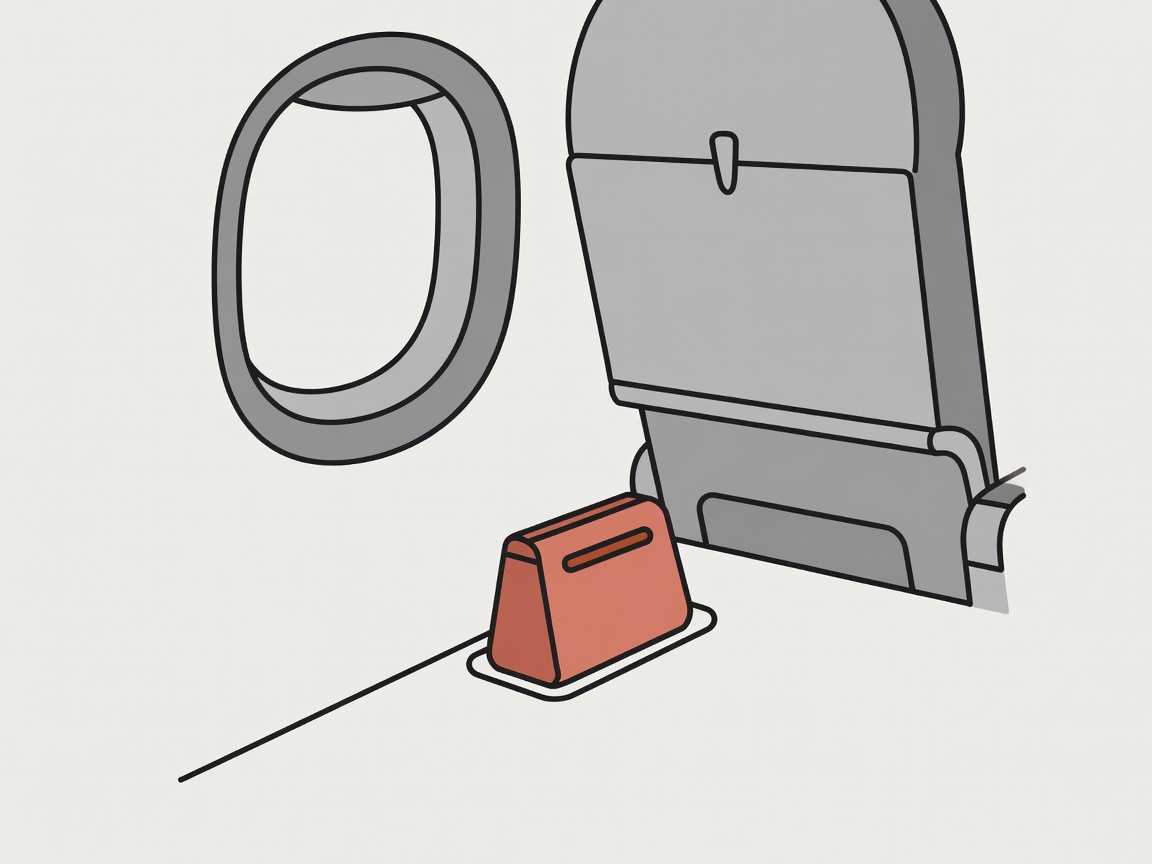
What “under the seat” really means
An under-seat bag is a personal item: something that must slide into the gap beneath the seat in front of you. That gap varies by aircraft and by row. Some seats have a support bar, some have in-flight entertainment boxes, and bulkhead and exit rows have no seat in front at all, so your item goes into the overhead bin for take-off and landing. It is wise to pick a bag that is a little shorter and softer than the limit, so it can be nudged into place.
It also affects comfort. A bag at your feet is a bag competing with your legs, and a stiff, boxy one will win that competition. Soft sides, a shape that flattens and a handle you can grab quickly make a big difference on a three-hour flight.
The numbers worth knowing
Limits differ a lot, and every airline decides its own. At the time of writing, Ryanair's free personal item is 40 × 20 × 25 cm, Wizz Air's is 40 × 30 × 20 cm and easyJet's is 45 × 36 × 20 cm. British Airways allows a personal item of 40 × 30 × 15 cm, Lufthansa 40 × 30 × 10 cm, and United's Basic Economy personal item is 17 × 10 × 9 inches. These figures change, so use them as a guide and check the size-check table and your airline's own page before you pack.
Notice how small the tightest ones are. A bag that is fine for easyJet may be too large for Ryanair, and a daypack that works for one carrier can be refused at another. If you fly several airlines, buy for the strictest one and enjoy the spare room everywhere else.
What goes inside
Packing for an under-seat bag is an exercise in subtraction. Wear the bulkiest layer and the heaviest shoes. Keep your passport, phone, charger and headphones at the top. Put liquids in a clear bag within 100 ml containers, and tuck a spare layer, a refillable bottle (empty through security) and a snack where you can reach them. Everything else must earn its place.
- Measure the bag packed and compare it with the strictest airline you may use.
- Choose soft sides that flatten, not a rigid box.
- Keep passport, phone and charger in one easy pocket.
- Put liquids in a clear bag with 100 ml containers.
- Wear your heaviest layer and shoes on board.
- Pack two outfits that mix and match, plus one spare of the small things.
Bags that tend to work
Compact backpacks from Cabin Zero are built around the under-seat idea, and the Osprey Daylite, at around 13 litres, is a classic for tiny trips. The Fjällräven Kånken, with its small boxy body, is stylish and light, though it has little padding. A well-sized tote or a crossbody bag also does the job if you like quick access. Always compare the manufacturer's current dimensions with your airline's limits rather than trusting the name alone.